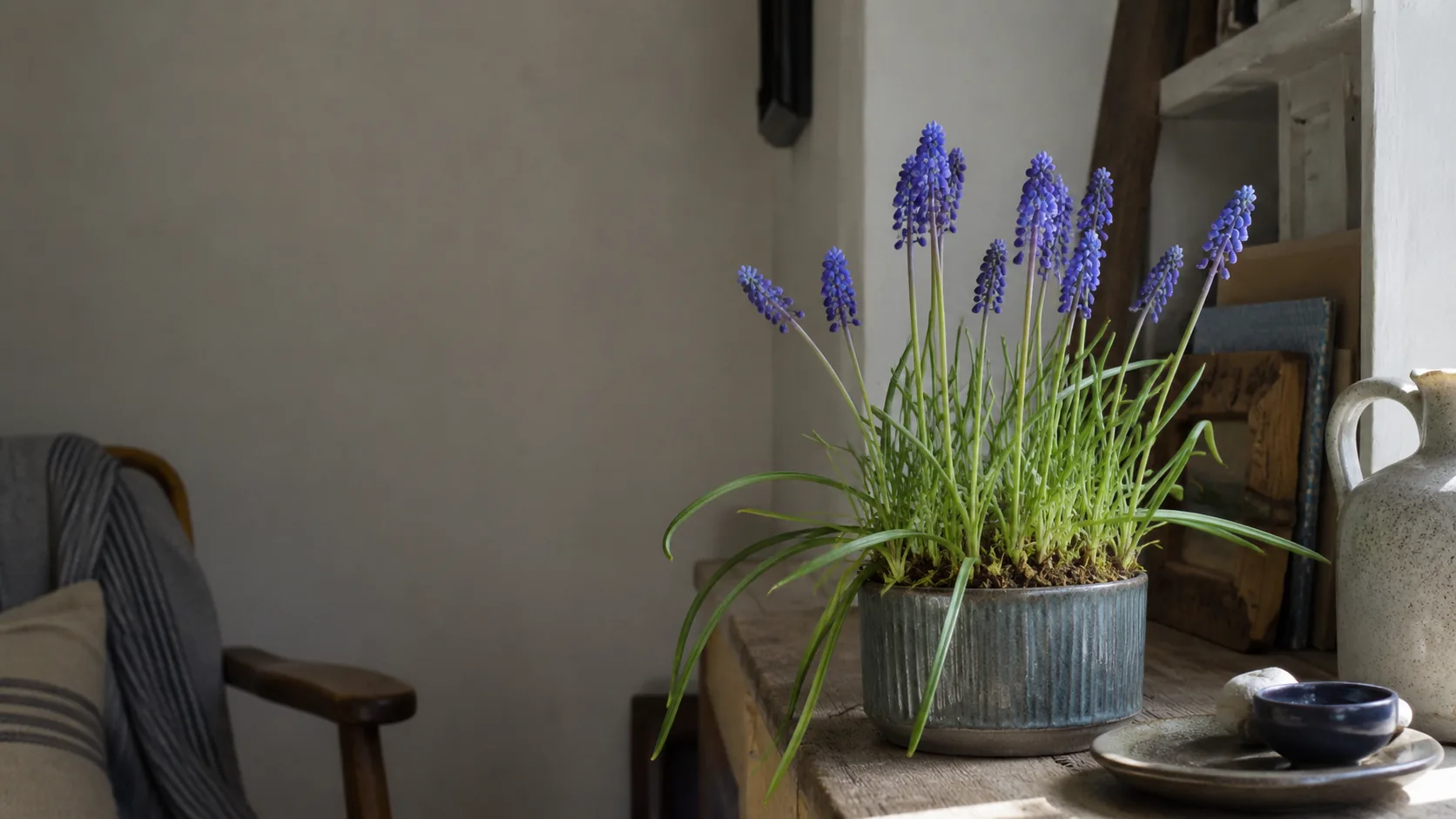
grape hyacinth
A compact spring bulb with dense violet-blue grape-like flower spikes and mid-green foliage, suited for cool bright windowsills with easy care.
Bright LightCompact ScaleFloor PlantNon-Toxic
Ornamental, Fragrantalso known as: grape hyacinths, armenian grape hyacinth
Assessment
Is This For Me?
light_mode
Light ExposureinfoIndoor light recommendation based on the plant's native habitat. "Bright indirect" means near a window but shielded from direct rays.
Bright Indirect — Close to a window but out of direct rays.
opacity
Watering HabitinfoHow forgiving this plant is when you miss a watering or accidentally overwater. High tolerance means more room for error.
High — Water when soil surface is dry.
psychology
Maintenance DifficultyinfoOverall ease of care rating. Beginner-friendly plants communicate their needs clearly through visible signs.
Medium — Needs basic observation skills.
straighten
Spatial RequirementinfoExpected mature size in a typical indoor environment. Actual size depends on light, pot size, and growing conditions.
Compact — Best for Living Room, Home Office.
schedule
Seasonal BehaviourinfoHow this plant's growth changes with the seasons. Use this to adjust your care routine throughout the year.
Cool Season Grower — Grows best in cooler months. May struggle in peak summer heat.
thermostat
Temperature NeedsinfoThis range represents the plant's survival tolerance. Optimal growing temperatures are typically 5-10°C higher than the minimum.
-20°C – 24°C — Cool-Tolerant — Standard indoor is warm enough. Tolerates cooler rooms — no special heating needed.
Appearance & Space
expand
Leaf Size
infoBetween 5 and 20 cm — the most common range for houseplants. Think peace lily or Chinese evergreen.Medium
texture
Leaf Surface
infoA gentle, soft sheen rather than a mirror finish. Subtle glow under indoor lighting.Semi Gloss
texture
Leaf Texture
infoA balanced, typical thickness. Flexible enough to bend, tough enough for everyday handling.Medium
shape_line
Leaf Shape
infoExtremely narrow, thread-like — barely 1–3 mm wide. Grass-like in appearance.Linear
content_copy
Leaf Type
infoOne continuous leaf blade, even if it has holes or shallow lobes (like Monstera).Simple
crop_portrait
Visual Form
infoGrows upward with some body at the base. Vertical presence without being skinny.Upright
grass
Foliage Density
infoPartially filled — some gaps but overall good coverage. A natural, balanced look.Moderate
Size Gauge
Height
Compact / Desk (0.2m)
Spread
Narrow (0.08m)
Display Position
Floor, Tabletop, Windowsill
Perfect for
Living Room, Home Office, Sunroom
Color Palette
Mid Green
Purple Burgundy
Core Care Logic
01
How Often to Water
Water when top inch of soil is dry
02
Finding the Right Light
Right next to a window, but shielded from direct rays. Look for a spot where you can see the sky but the sun never touches the leaves directly.
03
Choosing the Right Soil
Mix regular potting soil with about 30% perlite or orchid bark. This keeps water flowing through instead of pooling at the roots.
04
Temperature & Humidity
Happy in cooler rooms — anywhere between -20–24°C is fine. Avoid placing near radiators or heat vents. Average home humidity (40–60%) works well. No extra effort needed.
05
What to Expect
This is a steady, moderate grower — repot every couple of years and mostly takes care of itself. Just remove the occasional yellow leaf.
What Makes It Special
Early spring-blooming bulb with distinctive grape-like flower clusters, producing dense racemes of deep violet-blue, urn-shaped flowers each with a thin white rim. Each bulb produces 1-3 scapes with 20-40 tightly packed flowers.
auto_awesomeLeaves emerge in autumn, persist through winter, and flower in early spring (blooming for 3-4 weeks in April-May in Northern Hemisphere), representing a reversed growth cycle compared to most spring bulbs. Plants remain dormant from late spring through autumn.
auto_awesomeRecipient of the RHS Award of Garden Merit and recognized as an RHS Plants for Pollinators species, providing essential early-season nectar and pollen for bees and other pollinators emerging from hibernation.
Botanical Archive
Asparagaceae · Muscari
Muscari armeniacum H.J.Veitch
SE. Europe, Caucasus, Bulgaria
expand_more
Botanical Archive
Asparagaceae · Muscari
Muscari armeniacum H.J.Veitch
SE. Europe, Caucasus, Bulgaria
Storage and Survival Organ
Bulb
How this plant survives unfavorable seasons
Seasonal Growth Cycle
Seasonal Cool Active
When to expect new growth and feed actively
Clonal Spread
Basal Offsets
How this plant naturally expands in a pot
Attachment Strategy
Terrestrial
How this plant anchors itself in its native environment
Light Ecology
Dappled Partial
The light environment this plant evolved to thrive in
Growth Habit
Herbaceous Dieback
How persistent and structural the plant tissue is