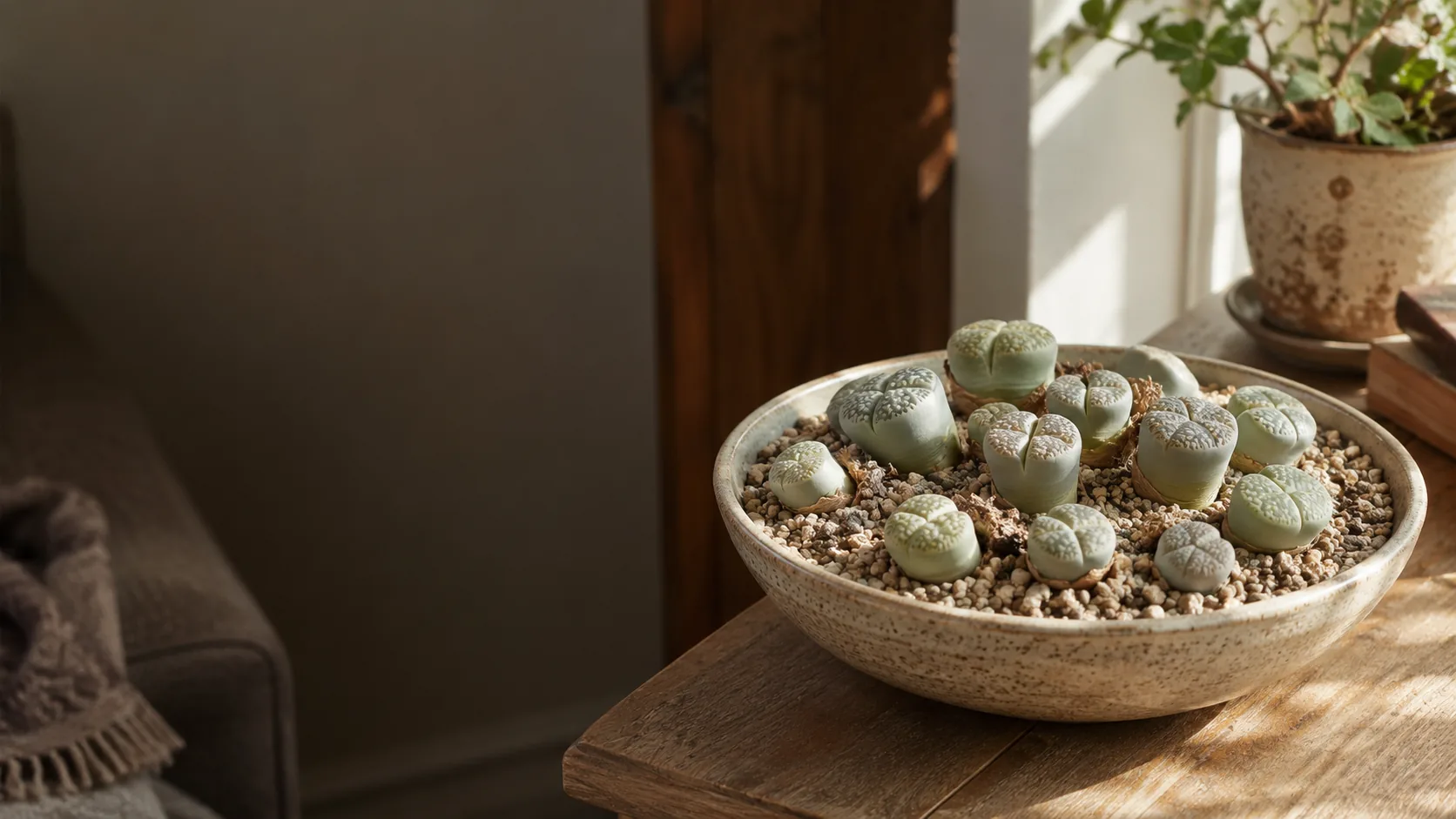
Living Stones
Stone-mimicking stemless succulents from southern Africa with silver-gray patterned leaf pairs, needing direct sun—perfect for sunny windowsills.
Full SunCompact ScaleWindowsill Plant
Ornamentalalso known as: Living Stone, Pebble Plant
Assessment
Is This For Me?
light_mode
Light ExposureinfoIndoor light recommendation based on the plant's native habitat. "Bright indirect" means near a window but shielded from direct rays.
Direct Sun Tolerant — Provide appropriate light conditions.
opacity
Watering HabitinfoHow forgiving this plant is when you miss a watering or accidentally overwater. High tolerance means more room for error.
Moderate — Consistent moisture preferred.
psychology
Maintenance DifficultyinfoOverall ease of care rating. Beginner-friendly plants communicate their needs clearly through visible signs.
Low — Requires experienced care.
straighten
Spatial RequirementinfoExpected mature size in a typical indoor environment. Actual size depends on light, pot size, and growing conditions.
Compact — Best for Bedroom, Living Room, Home Office.
schedule
Seasonal BehaviourinfoHow this plant's growth changes with the seasons. Use this to adjust your care routine throughout the year.
Needs a Dormancy — Must have a strict rest period. Forcing growth year-round will weaken or kill it.
thermostat
Temperature NeedsinfoThis range represents the plant's survival tolerance. Optimal growing temperatures are typically 5-10°C higher than the minimum.
Cool-Tolerant — Standard indoor is warm enough. Tolerates cooler rooms — no special heating needed.
Appearance & Space
expand
Leaf Size
infoSmaller than 5 cm — typical of delicate, fine-textured plants like baby tears or creeping sedums.Small
texture
Leaf Surface
infoFlat and velvety with no reflections. Light is absorbed evenly for a calm, muted look.Matte
texture
Leaf Texture
infoPlump and water-filled — press gently and it feels spongy. Designed to store moisture.Succulent
shape_line
Leaf Shape
infoNearly circular — as wide as it is long. Unusual and charming.Round
content_copy
Leaf Type
infoOne continuous leaf blade, even if it has holes or shallow lobes (like Monstera).Simple
crop_portrait
Visual Form
infoA low, compact dome shape — small enough for desks and shelves.Mounding
grass
Foliage Density
infoOpen and airy — you can see through to the stems and structure. Light, architectural feel.Sparse
palette
Variegation
infoTiny dots or flecks of colour dusted across the leaf surface, like a sprinkled finish.Speckled
Size Gauge
Height
Compact / Desk (0.08m)
Spread
Narrow (0.05m)
Display Position
Windowsill, Tabletop, Shelf, Plant Stand
Perfect for
Living Room, Home Office, Sunroom, Bedroom
Color Palette
Silver Gray
Mid Green
Bronze
Deep Green
Core Care Logic
01
How Often to Water
Let the soil dry out almost completely before watering again. When in doubt, wait two more days.
02
Finding the Right Light
Can handle direct sunlight, but introduce it gradually over a week to prevent leaf burn.
03
Choosing the Right Soil
Go for a chunky, open mix — think orchid bark, perlite, and a bit of horticultural charcoal. Avoid dense, peat-heavy soils.
04
Temperature & Humidity
Happy in cooler rooms — anywhere between 13–24°C is fine. Avoid placing near radiators or heat vents. No humidity concerns — normal indoor air is perfectly fine.
05
What to Expect
This is a slow grower — it won't outgrow its spot anytime soon, so enjoy it as-is but benefits from occasional pruning to keep its shape and remove dead foliage.
What Makes It Special
Leaf pairs mimic stones or pebbles through color, pattern, and shape as camouflage in arid rocky habitats of southern Africa.
auto_awesomeTranslucent 'windows' on leaf surfaces allow light to enter for photosynthesis while protecting chlorophyll-rich tissue from harsh conditions.
auto_awesomeEach plant maintains only one pair of succulent leaves at a time, with old leaves withering as new leaves emerge from within.
Botanical Archive
Aizoaceae · Lithops
Lithops N.E.Br.
Namibia, South Africa, Botswana
Genus-level entry — values describe the commonly grown form of this variable genus.
expand_more
Botanical Archive
Aizoaceae · Lithops
Lithops N.E.Br.
Namibia, South Africa, Botswana
Genus-level entry — values describe the commonly grown form of this variable genus.
Storage and Survival Organ
Fleshy Leaves
How this plant survives unfavorable seasons
Seasonal Growth Cycle
Dormancy Required
When to expect new growth and feed actively
Clonal Spread
Basal Offsets
How this plant naturally expands in a pot
Root Sensitivity
High
How carefully you should handle roots during repotting
Attachment Strategy
Terrestrial
How this plant anchors itself in its native environment
Root System
Taproot
The structure and behavior of the root system
Light Ecology
Full Exposure
The light environment this plant evolved to thrive in
Growth Habit
Semi Woody
How persistent and structural the plant tissue is