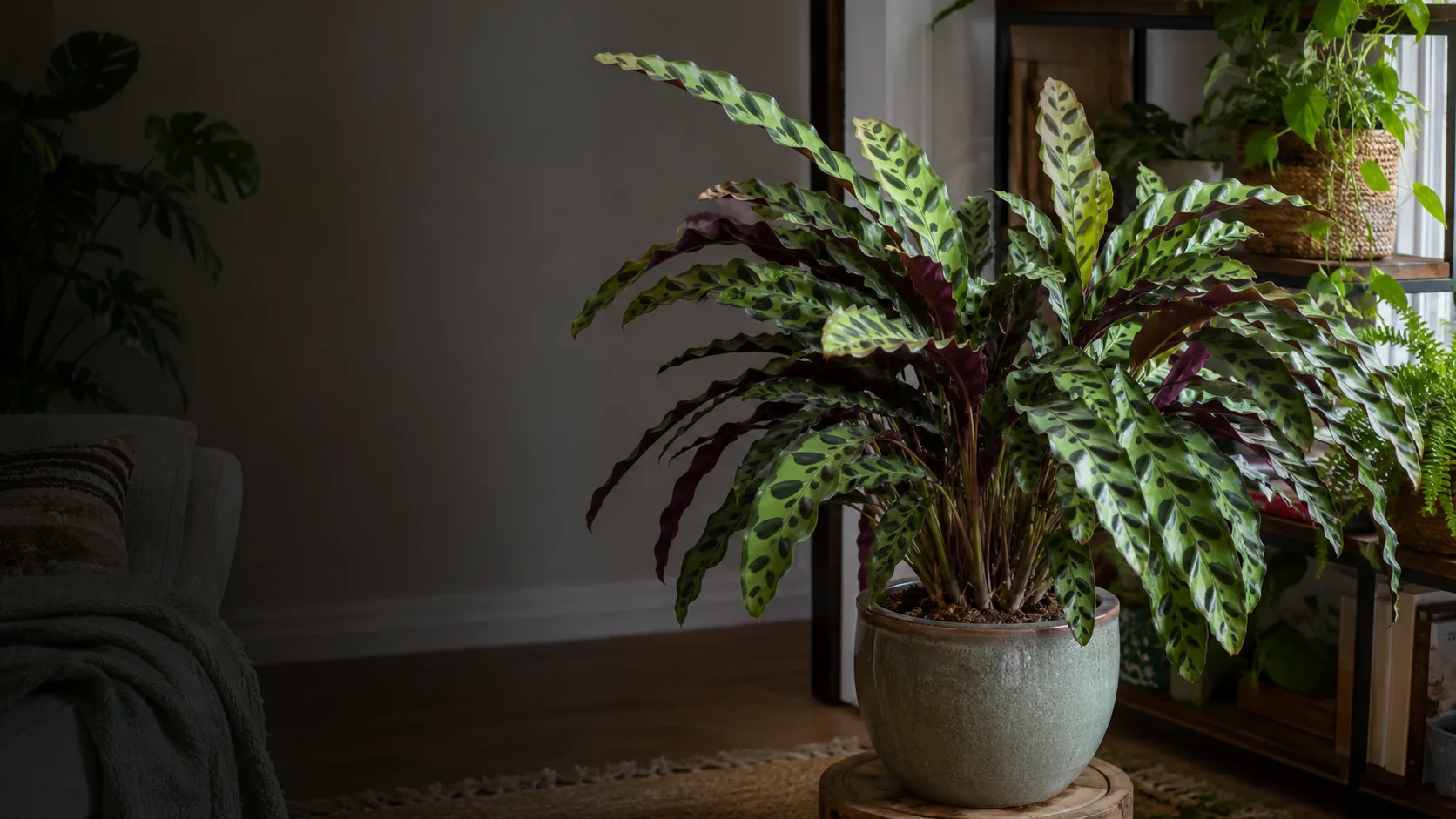
Rattlesnake Plant
Tropical clumping plant with distinctive rattlesnake-patterned leaves and purple undersides, best in humid spots with medium indirect light.
Medium to Bright LightMedium ScaleTabletop PlantNon-Toxic
Ornamentalalso known as: Rattlesnake Calathea, Prayer Plant
Assessment
Is This For Me?
light_mode
Light ExposureinfoIndoor light recommendation based on the plant's native habitat. "Bright indirect" means near a window but shielded from direct rays.
Medium To Bright Indirect — Needs strong ambient light. Avoid direct hot sun.
opacity
Watering HabitinfoHow forgiving this plant is when you miss a watering or accidentally overwater. High tolerance means more room for error.
Moderate — Consistent moisture preferred.
psychology
Maintenance DifficultyinfoOverall ease of care rating. Beginner-friendly plants communicate their needs clearly through visible signs.
Medium — Needs basic observation skills.
straighten
Spatial RequirementinfoExpected mature size in a typical indoor environment. Actual size depends on light, pot size, and growing conditions.
Medium — Best for Bedroom, Living Room, Bathroom.
schedule
Seasonal BehaviourinfoHow this plant's growth changes with the seasons. Use this to adjust your care routine throughout the year.
Slows in Winter — Growth dips during shorter days. Ease off watering and skip fertilizer until spring.
thermostat
Temperature NeedsinfoThis range represents the plant's survival tolerance. Optimal growing temperatures are typically 5-10°C higher than the minimum.
16°C – 30°C — Standard Indoor — Typical room temperature works well. No extra attention needed.
Appearance & Space
expand
Leaf Size
infoBetween 20 and 50 cm — bold statement leaves. Fiddle-leaf fig and bird of paradise fall here.Large
texture
Leaf Surface
infoPolished, mirror-like shine. Light catches the surface clearly, creating vivid reflections.Glossy
texture
Leaf Texture
infoA balanced, typical thickness. Flexible enough to bend, tough enough for everyday handling.Medium
shape_line
Leaf Shape
infoLong and narrow, tapering to a point at both ends — like a lance head. About 3–6 times longer than wide.Lance Shaped
content_copy
Leaf Type
infoOne continuous leaf blade, even if it has holes or shallow lobes (like Monstera).Simple
crop_portrait
Visual Form
infoLeaves shoot up from the centre and arc outward like a fountain spray.Upright Fountain
grass
Foliage Density
infoPartially filled — some gaps but overall good coverage. A natural, balanced look.Moderate
palette
Variegation
infoTiny dots or flecks of colour dusted across the leaf surface, like a sprinkled finish.Speckled
Size Gauge
Height
Medium / Tabletop (0.75m)
Spread
Compact (0.6m)
Display Position
Tabletop, Floor, Shelf
Perfect for
Bathroom, Bedroom, Living Room
Color Palette
Mid Green
Purple Burgundy
Core Care Logic
01
How Often to Water
Check the soil frequently — it should never dry out completely. When the surface feels just barely dry, it's time to water.
02
Finding the Right Light
Near an east or west window with a sheer curtain. Your hand should cast a soft but defined shadow.
03
Choosing the Right Soil
Mix regular potting soil with about 30% perlite or orchid bark. This keeps water flowing through instead of pooling at the roots.
04
Temperature & Humidity
Comfortable in normal room temperatures, 16–30°C. Nothing special needed. Thrives in high humidity (60–80%). A bathroom or kitchen spot is ideal, or use a humidifier nearby.
05
What to Expect
This is a steady, moderate grower — repot every couple of years and mostly takes care of itself. Just remove the occasional yellow leaf.
What Makes It Special
Known as 'Rattlesnake Plant' due to distinctive leaf pattern resembling a rattlesnake's skin - dark green elliptic blotches on pale green background with purple/maroon undersides
auto_awesomeExhibits nyctinasty (prayer plant behavior) - leaves fold upward at night and spread horizontally during day to optimize light capture and regulate transpiration
auto_awesomeNative to the Atlantic Forest of Brazil (Mata Atlântica), a biodiversity hotspot with many endemic species
Botanical Archive
Marantaceae · Goeppertia
Goeppertia insignis (W.Bull ex W.E.Marshall) J.M.A.Braga, L.J.T.Cardoso & R.Couto
Brazil (Rio de Janeiro)
expand_more
Botanical Archive
Marantaceae · Goeppertia
Goeppertia insignis (W.Bull ex W.E.Marshall) J.M.A.Braga, L.J.T.Cardoso & R.Couto
Brazil (Rio de Janeiro)
Storage and Survival Organ
Rhizome
How this plant survives unfavorable seasons
Seasonal Growth Cycle
Year Round Mild Winter Slow
When to expect new growth and feed actively
Clonal Spread
Rhizomes
How this plant naturally expands in a pot
Root Sensitivity
Low
How carefully you should handle roots during repotting
Attachment Strategy
Terrestrial
How this plant anchors itself in its native environment
Root System
Rhizomatous
The structure and behavior of the root system
Light Ecology
Filtered Shade
The light environment this plant evolved to thrive in
Growth Habit
Herbaceous Dieback
How persistent and structural the plant tissue is