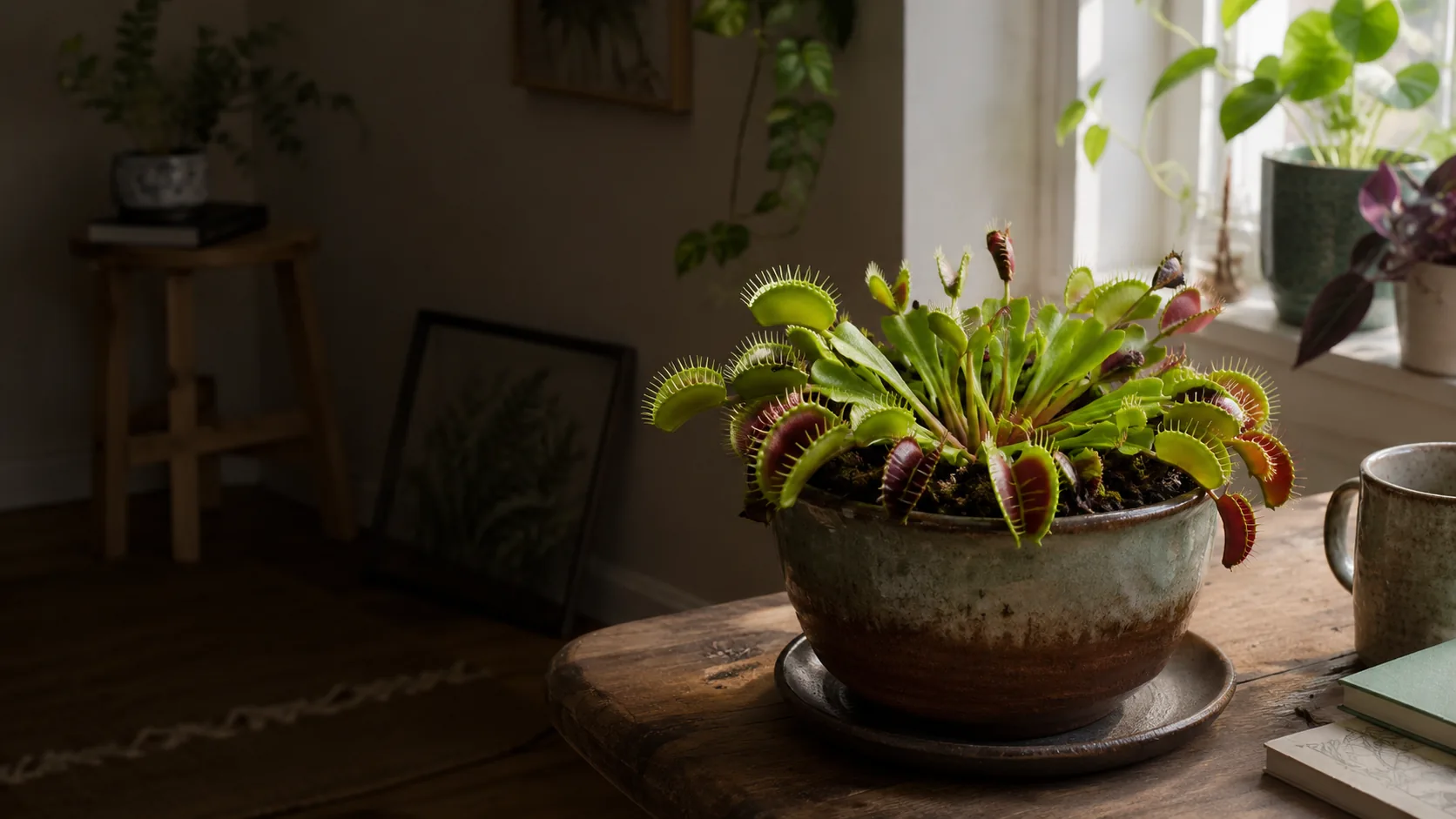
Venus flytrap
A carnivorous rosette with green-and-red snap-trap leaves, needing bright light and moist acidic soil—perfect for curious windowsill collectors.
Bright LightCompact ScaleWindowsill PlantNon-Toxic
Ornamentalalso known as: Venus fly trap, Venus' fly trap
Assessment
Is This For Me?
light_mode
Light ExposureinfoIndoor light recommendation based on the plant's native habitat. "Bright indirect" means near a window but shielded from direct rays.
Bright Indirect To Some Direct — Morning sun is beneficial. Avoid midday scorch.
opacity
Watering HabitinfoHow forgiving this plant is when you miss a watering or accidentally overwater. High tolerance means more room for error.
Moderate — Consistent moisture preferred.
psychology
Maintenance DifficultyinfoOverall ease of care rating. Beginner-friendly plants communicate their needs clearly through visible signs.
Low — Requires experienced care.
straighten
Spatial RequirementinfoExpected mature size in a typical indoor environment. Actual size depends on light, pot size, and growing conditions.
Compact — Best for Living Room.
schedule
Seasonal BehaviourinfoHow this plant's growth changes with the seasons. Use this to adjust your care routine throughout the year.
Needs a Dormancy — Must have a strict rest period. Forcing growth year-round will weaken or kill it. May shed some foliage when the season changes.
thermostat
Temperature NeedsinfoThis range represents the plant's survival tolerance. Optimal growing temperatures are typically 5-10°C higher than the minimum.
10°C – 27°C — Cool-Tolerant — Standard indoor is warm enough. Tolerates cooler rooms — no special heating needed.
Appearance & Space
expand
Leaf Size
infoBetween 5 and 20 cm — the most common range for houseplants. Think peace lily or Chinese evergreen.Medium
texture
Leaf Texture
infoA balanced, typical thickness. Flexible enough to bend, tough enough for everyday handling.Medium
shape_line
Leaf Shape
infoA clear notch at the base gives a heart outline. Romantic and instantly recognisable.Heart Shaped
content_copy
Leaf Type
infoOne continuous leaf blade, even if it has holes or shallow lobes (like Monstera).Simple
crop_portrait
Visual Form
infoLeaves radiate from the centre in a circular pattern. Star-like from above.Rosette
grass
Foliage Density
infoPartially filled — some gaps but overall good coverage. A natural, balanced look.Moderate
Size Gauge
Height
Compact / Desk (0.23m)
Spread
Narrow (0.18m)
Display Position
Windowsill, Tabletop
Perfect for
Windowsill, Sunroom, Living Room
Color Palette
Mid Green
Red
Core Care Logic
01
How Often to Water
Check the soil frequently — it should never dry out completely. When the surface feels just barely dry, it's time to water.
02
Finding the Right Light
Close to a window with a few hours of gentle morning sun. A sheer curtain helps soften harsh afternoon rays.
03
Choosing the Right Soil
Mix regular potting soil with about 30% perlite or orchid bark. This keeps water flowing through instead of pooling at the roots.
04
Temperature & Humidity
Happy in cooler rooms — anywhere between 10–27°C is fine. Avoid placing near radiators or heat vents. Likes a bit more moisture in the air (50–60%). Grouping it with other plants or a pebble tray helps.
05
What to Expect
This is a slow grower — it won't outgrow its spot anytime soon, so enjoy it as-is but benefits from occasional pruning to keep its shape and remove dead foliage.
What Makes It Special
Carnivorous plant with rapid-trap mechanism: hinged leaf lobes snap shut in ~0.1 seconds when trigger hairs are touched twice within 20 seconds. Digests insects and occasionally small frogs using enzymes over 4-10 days to obtain nitrogen/phosphorus from nutrient-poor bog soils. Native only to a 100-mile radius of Wilmington, North Carolina—one of the most geographically restricted carnivorous plants. Listed as Vulnerable (IUCN) and CITES Appendix II due to habitat loss and overcollection. Darwin called it 'one of the most wonderful plants in the world'. Each trap can close only 3 times before dying.
Botanical Archive
Droseraceae · Dionaea
Dionaea muscipula J.Ellis
North Carolina, South Carolina
expand_more
Botanical Archive
Droseraceae · Dionaea
Dionaea muscipula J.Ellis
North Carolina, South Carolina
Storage and Survival Organ
Rhizome
How this plant survives unfavorable seasons
Seasonal Growth Cycle
Dormancy Required
When to expect new growth and feed actively
Clonal Spread
Basal Offsets
How this plant naturally expands in a pot
Root Sensitivity
Low
How carefully you should handle roots during repotting
Attachment Strategy
Terrestrial
How this plant anchors itself in its native environment
Root System
Rhizomatous
The structure and behavior of the root system
Light Ecology
Full Exposure
The light environment this plant evolved to thrive in
Growth Habit
Herbaceous Dieback
How persistent and structural the plant tissue is