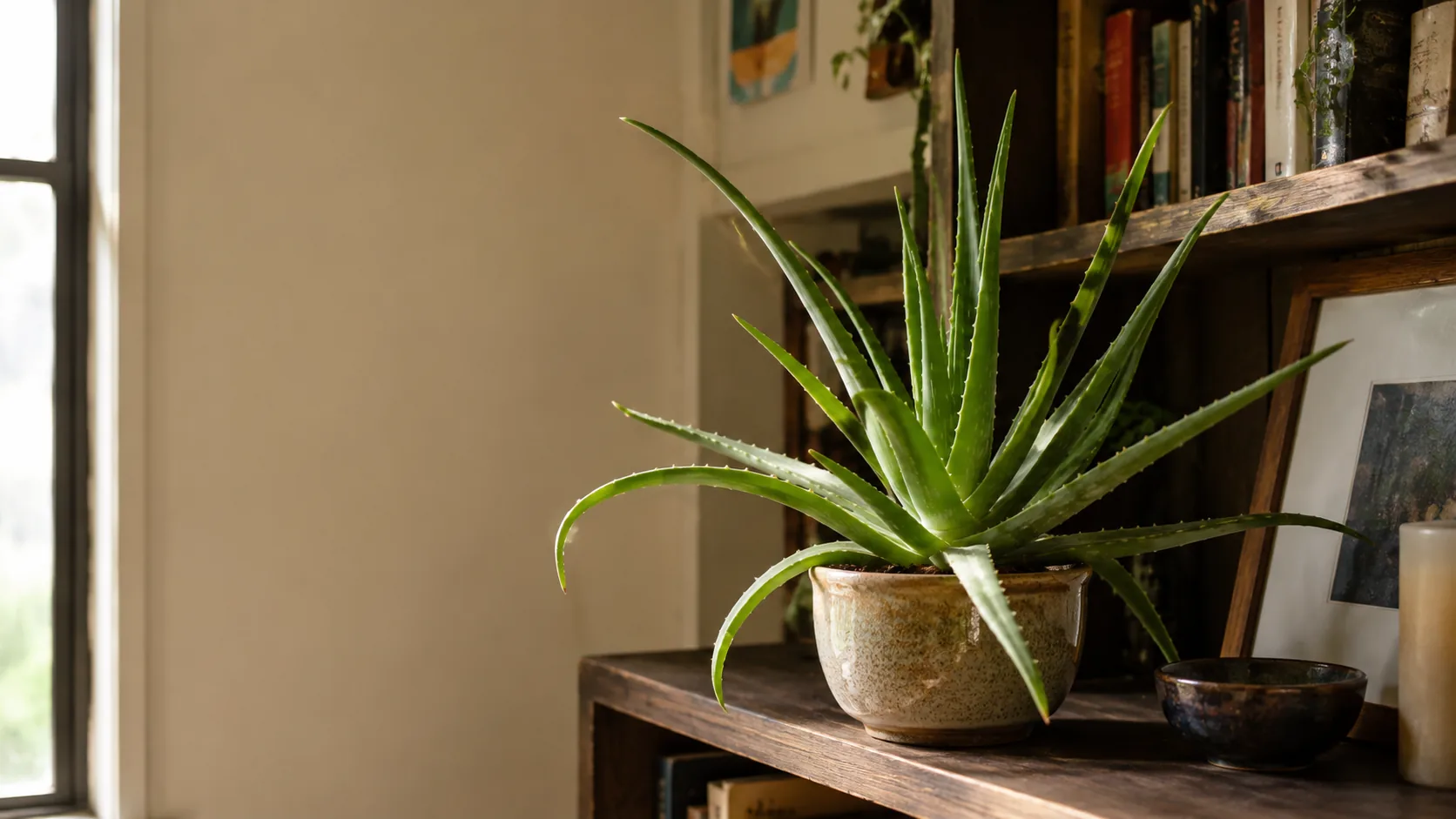
aloe vera
A stemless succulent rosette with fleshy, lance-shaped green to blue-green leaves, ideal for bright windowsills and easy indoor care.
Full SunSmall ScaleWindowsill PlantToxic to Pets
Ornamental, Medicinalalso known as: aloe, barbados aloe
Assessment
Is This For Me?
light_mode
Light ExposureinfoIndoor light recommendation based on the plant's native habitat. "Bright indirect" means near a window but shielded from direct rays.
Direct Sun Tolerant — Provide appropriate light conditions.
opacity
Watering HabitinfoHow forgiving this plant is when you miss a watering or accidentally overwater. High tolerance means more room for error.
Moderate — Consistent moisture preferred.
psychology
Maintenance DifficultyinfoOverall ease of care rating. Beginner-friendly plants communicate their needs clearly through visible signs.
Medium — Needs basic observation skills.
straighten
Spatial RequirementinfoExpected mature size in a typical indoor environment. Actual size depends on light, pot size, and growing conditions.
Small — Best for Living Room, Home Office.
schedule
Seasonal BehaviourinfoHow this plant's growth changes with the seasons. Use this to adjust your care routine throughout the year.
Slows in Winter — Growth dips during shorter days. Ease off watering and skip fertilizer until spring.
thermostat
Temperature NeedsinfoThis range represents the plant's survival tolerance. Optimal growing temperatures are typically 5-10°C higher than the minimum.
10°C – 27°C — Cool-Tolerant — Standard indoor is warm enough. Tolerates cooler rooms — no special heating needed.
Appearance & Space
expand
Leaf Size
infoBetween 20 and 50 cm — bold statement leaves. Fiddle-leaf fig and bird of paradise fall here.Large
texture
Leaf Surface
infoA gentle, soft sheen rather than a mirror finish. Subtle glow under indoor lighting.Semi Gloss
texture
Leaf Texture
infoPlump and water-filled — press gently and it feels spongy. Designed to store moisture.Succulent
shape_line
Leaf Shape
infoLong and narrow, tapering to a point at both ends — like a lance head. About 3–6 times longer than wide.Lance Shaped
content_copy
Leaf Type
infoOne continuous leaf blade, even if it has holes or shallow lobes (like Monstera).Simple
crop_portrait
Visual Form
infoLeaves radiate from the centre in a circular pattern. Star-like from above.Rosette
grass
Foliage Density
infoPartially filled — some gaps but overall good coverage. A natural, balanced look.Moderate
Size Gauge
Height
Small / Shelf (0.5m)
Spread
Moderate (0.75m)
Display Position
Windowsill, Tabletop, Plant Stand
Perfect for
Living Room, Home Office, Sunroom
Color Palette
Mid Green
Blue Green
Silver Gray
Core Care Logic
01
How Often to Water
Let the soil dry out almost completely before watering again. When in doubt, wait two more days.
02
Finding the Right Light
Can handle direct sunlight, but introduce it gradually over a week to prevent leaf burn.
03
Choosing the Right Soil
Go for a chunky, open mix — think orchid bark, perlite, and a bit of horticultural charcoal. Avoid dense, peat-heavy soils.
04
Temperature & Humidity
Happy in cooler rooms — anywhere between 10–27°C is fine. Avoid placing near radiators or heat vents. No humidity concerns — normal indoor air is perfectly fine.
05
What to Expect
This is a slow grower — it won't outgrow its spot anytime soon, so enjoy it as-is and mostly takes care of itself. Just remove the occasional yellow leaf.
What Makes It Special
Aloe vera is a stemless succulent perennial native to the Arabian Peninsula, distinctive for its thick fleshy leaves containing a clear polysaccharide gel (acemannan) and yellow latex (aloin). The gel has been used for centuries in topical treatments for burns, wounds, and skin conditions. Oral consumption of latex extracts can cause adverse effects. The plant spreads by basal offsets ('pups'), producing clusters of rosettes over time. Aloe vera forms arbuscular mycorrhizal associations with soil fungi to enhance nutrient uptake. Widely cultivated and naturalized globally, it is considered invasive in many regions and is produced commercially in numerous countries for cosmetics and medicinal industries.
Botanical Archive
Asphodelaceae · Aloe
Aloe vera (L.) Burm.f.
Oman, United Arab Emirates
expand_more
Botanical Archive
Asphodelaceae · Aloe
Aloe vera (L.) Burm.f.
Oman, United Arab Emirates
Storage and Survival Organ
Fleshy Leaves
How this plant survives unfavorable seasons
Seasonal Growth Cycle
Year Round Mild Winter Slow
When to expect new growth and feed actively
Clonal Spread
Basal Offsets
How this plant naturally expands in a pot
Root Sensitivity
High
How carefully you should handle roots during repotting
Phase Change
Size Or Age Triggered
How the plant's appearance may change as it matures
Attachment Strategy
Terrestrial
How this plant anchors itself in its native environment
Root System
Fleshy Roots
The structure and behavior of the root system
Light Ecology
Full Exposure
The light environment this plant evolved to thrive in
Growth Habit
Semi Woody
How persistent and structural the plant tissue is